
Chapter 5
This is my ultra cycling mindset at TBR — and how I dealt with the unexpected. At km 600, I spent four hours covering 14 kilometres. It was too hot. My legs were there. My head wasn’t.
That’s the moment the TBR becomes a different race.
The Balkans are different
I’ve finished several ultra-cycling races. Each one tests you differently. But the Trans Balkan Race requires something specific — a mental consistency that other races don’t demand at the same level.
82% off-road. Remote sections that go on for hours with nobody around. No signal. No shop. No rider in sight. Just you, the terrain, and whatever is happening in your head.
On a standard ultra you manage saddle sores, cold, rain, fatigue, sleep, food. On the TBR you manage all of that — plus long sections with nothing and no one. The landscapes are extraordinary. They make you forget the pain. But the moment something goes wrong out there, the mental game becomes everything.
Km 600: four hours on 14 kilometres
It was too hot. I’d eaten a heavy breakfast. The doubt arrived quietly — and the heat amplified it into something heavier.
I didn’t solve it. I just kept moving. One kilometre at a time, toward the next village. A hundred kilometres of nothing ahead. I didn’t think about that. I thought about the next kilometre.
A good meal in that village reset everything. That’s the TBR — a single hot plate of food can be the difference between a crisis and a race.
The puncture before Mostar
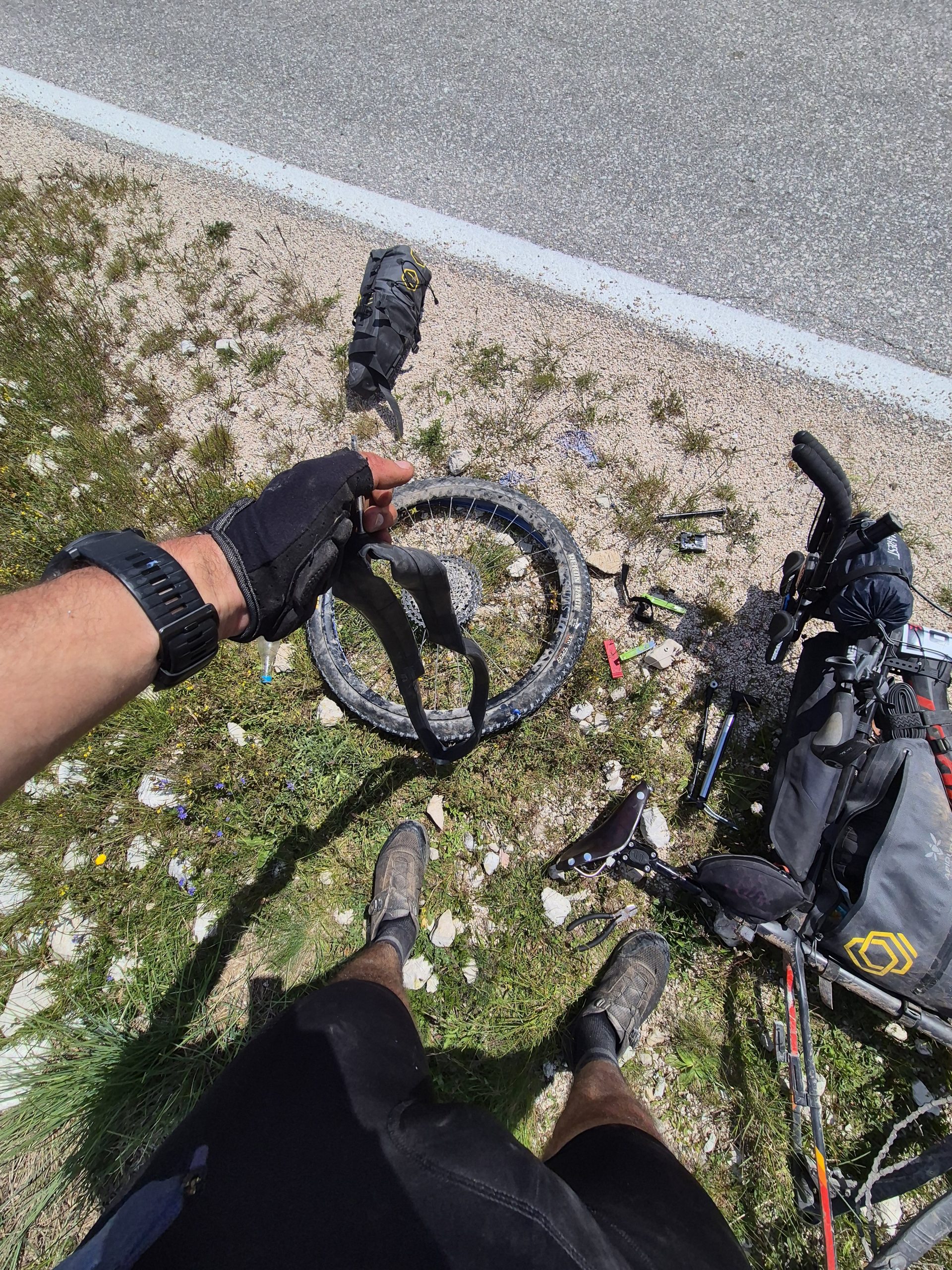
Before Mostar, a puncture. The tubeless wasn’t holding — I switched to an inner tube. Not a disaster. A delay.
Then, back on the road, a shepherd’s dog blocked the path. I waited for a car to pass and slipped behind it. Problem solved.
Two things in the same hour. On the TBR, that’s normal. The question is never whether something will go wrong — it will. The question is how fast you reset.
How to stay mentally consistent – ultra cycling mindset on the TBR
Relativise constantly. A puncture is not a crisis. A bad hour is not a bad race. Zoom out. You’re crossing four countries on a bike. Whatever just happened is small.
Hunt riders ahead. When the motivation drops, find someone on the tracker ahead of you and close the gap. It doesn’t matter what place you’re in. Having a target — even one you never catch — keeps the legs turning.
Play with the pain — but know the line. Discomfort is part of the race. Push through it. But distinguish between race discomfort and a signal from your body that something is wrong. One you ride through. The other you stop for.
Keep your head clear. Fatigue clouds decisions. When you’re tired, you make bad calls — wrong turns, missed resupply, unnecessary risks. Sleep, eat, and make your big decisions when you’re rested.
The landscapes will do some of the work. The Balkans are extraordinary. There will be moments — a sunrise over a karst plateau, a descent into a valley — where the race becomes the most beautiful thing you’ve ever done. Let those moments carry you.
The principle
The TBR doesn’t break you physically. It tests your ability to keep moving when everything feels hard at the same time.
Stay consistent. Relativise. Advance. The finish line in Risan exists because people kept going when it would have been easier to stop.
The last kilometres of an ultra are like progress in life when things get hard — painful, slow, and completely worth it. You don’t see the finish line until you’re almost there. But every kilometre you didn’t stop brought you closer.
This is the final chapter of The Ultracyclist Files TBR series. Read the full series: packing system, clothing strategy, sleep kit, nutrition strategy — all written from 7 days and 6 hours in the Balkans.
Follow the journey on Instagram → @gravel_bikeandride📸📲